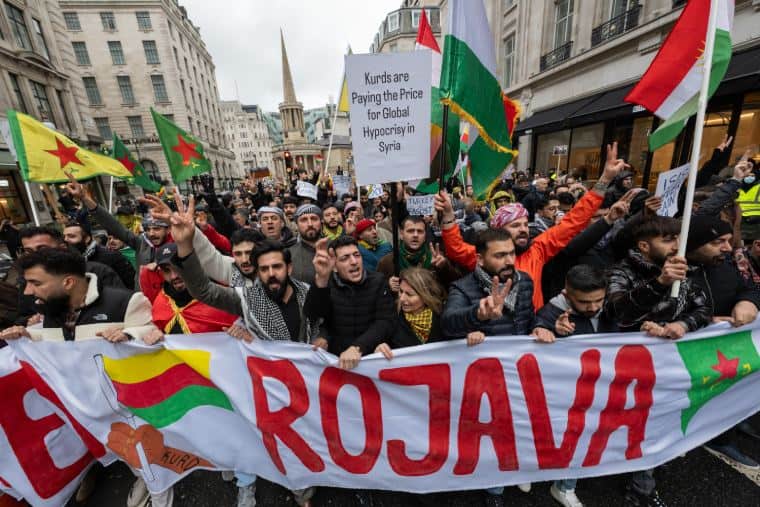
The Jineolojî Academy Rojava has prepared a new report detailing war crimes committed in North and East Syria. The report focuses on analysing different forms of war crimes perpetrated by forces connected to the HTS and ISIS, in parallel with Turkish military forces, including torture, the killing of children, the destruction of culture and property.
During the first days of 2026, the security balance in Northern and Eastern Syria severely deteriorated. The information gathered by the Jineolojî Academy indicates that during this period, elements of Hay’at Tahrir al-Sham (HTS) and ISIS cells have operated simultaneously and in a coordinated manner. These attacks have progressed in parallel with Turkish military pressure and physical interventions on the border. This situation indicates that the attacks on the region are not isolated incidents, but part of a planned and multifaceted war concept.
The first phase of the attacks began on 6 January 2026 in the Sheikh Maqsoud and Ashrafieh neighbourhoods of Aleppo. These neighbourhoods, long home to a Kurdish population, were subjected to direct attacks targeting civilian life. At the same time, similar attacks occurred in the predominantly Christian Benni Zeid area in northern Aleppo, revealing that the conflict was not only military but also targeted ethnic and religious communities. These attacks were considered a deliberate attempt at destabilisation, aimed at disrupting the common life between different communities.
The attacks, which began on the Aleppo front, quickly spread to the Raqqa region. ISIS cells reactivated their long-standing, clandestine operations. Assassinations, bombings and sabotage were carried out. The aim of these attacks was to recreate an atmosphere of fear in Raqqa and to weaken the security struggle that the SDF has been waging against ISIS for years. During this period, SDF forces were forced to conduct defensive operations to both ensure the safety of the population and prevent the re-establishment of ISIS. At the same time, fighting and clashes on the Deir ez-Zor front intensified. Particularly in rural areas, ISIS-affiliated groups laid ambushes against our checkpoints and local security forces, and attempted to destabilise the region through tribal structures. In response to these attacks, the SDF was forced to defend multiple fronts simultaneously, which placed a significant strain on regional security.As January progressed, the focus of the attacks shifted to Kobanî and its surrounding area. Kobanî was targeted in particular because it is a symbol of the historic resistance against ISIS. According to the SDF, during this period, Turkey carried out intense attacks with drones. At the same time, Hay’at Tahrir al-Sham (HTS) and armed groups affiliated with the Turkish state intensified their ground attacks on the Kobanî countryside. The main aim of these attacks was to weaken Kobanî’s defensive capabilities and to force civilians to flee. This is clearly evident in videos published by HTS members on social media and on television channels close to the group.
Our assessment, as the Rojava Academy of Jineolojî, is that this wave of attacks, which began on 6 January 2026, not only aims to achieve military results but also to produce political and social outcomes. These waves of attacks, which begin in the Kurdish and Syrian neighbourhoods of Aleppo and extend as far as the Raqqa and Deir ez-Zor lines, target the shared life of the peoples and the model of Autonomous Administration in North and East
Syria. The ongoing attacks and siege on Kobanî show that this war concept is continuing and poses a serious threat to the region’s stability. The SDF, YPG and YPJ emphasise that their main objective in this process is to ensure the safety of the people; prevent the resurgence of ISIS; stop the massacres of HTS against them; and protect the will for a shared life established in North and East Syria. We are writing this document on 26 January 2026. That is, the anniversary of the expulsion of ISIS from Kobanî in 2014. In this region, there are fierce attacks by HTS and ISIS.